
Thinking about using credit card piggybacking to qualify for a mortgage?
Here’s the truth most TikTok and YouTube “credit hacks” won’t tell you: lenders often ignore it and sometimes penalize it.
Yes, it might bump your credit score temporarily. But that bump doesn’t necessarily mean you’re mortgage-ready. What lenders care about most isn’t just your score; it’s your ability to manage your own credit responsibly over time.
In this article, you’ll learn:
- Why lenders ignore authorized users
- When piggybacking actually hurts approvals
- What builds real mortgage-ready credit
Let’s get started!
Table of Contents
What Is Piggybacking Credit (Authorized-User Strategy)?
Credit Card Piggybacking happens when someone adds you as an authorized user on their existing credit card account. This strategy is often promoted online as a fast way to boost your credit score, and in theory, it makes sense.
When you’re added as an authorized user, the payment history, account age, and credit utilization of that card get reflected on your credit report (per FICO’s scoring model). That means if the cardholder has a long history of on-time payments and low balances, their good behavior can appear as if it’s yours too.
According to Experian, “Becoming an authorized user on someone else’s credit card account can be a great way to establish or improve your credit history.”
So far, so good… right?
Not quite. Because while this tactic may help your score, it doesn’t build your creditworthiness. Another Experian article notes: “A good credit score that is based on being an authorized user may not get you an approval when you need it, even when you have a good income.”
How It Can Help Your Credit Score
Let’s be fair, there are some short-term benefits to Credit Card Piggybacking, especially for those just starting their credit journey.
- It Adds a Positive Payment History
If the primary cardholder has years of consistent on-time payments, you inherit that record, boosting your score’s “payment history” factor, which makes up 35% of your FICO score. - It Extends Your Credit Age
One of the biggest challenges for new borrowers is a “young” credit profile. Being added to a long-standing card can help lengthen your average account age. - It Lowers Overall Utilization
Credit utilization (your balance compared to your credit limit) makes up 30% of your FICO score. If the main cardholder keeps their utilization low, that can improve yours, too. - It Can Give a Temporary Boost
Sometimes, that short-term increase can help you reach key mortgage score thresholds, for example, 620 for FHA, 640 for USDA, or 680+ for conventional loans.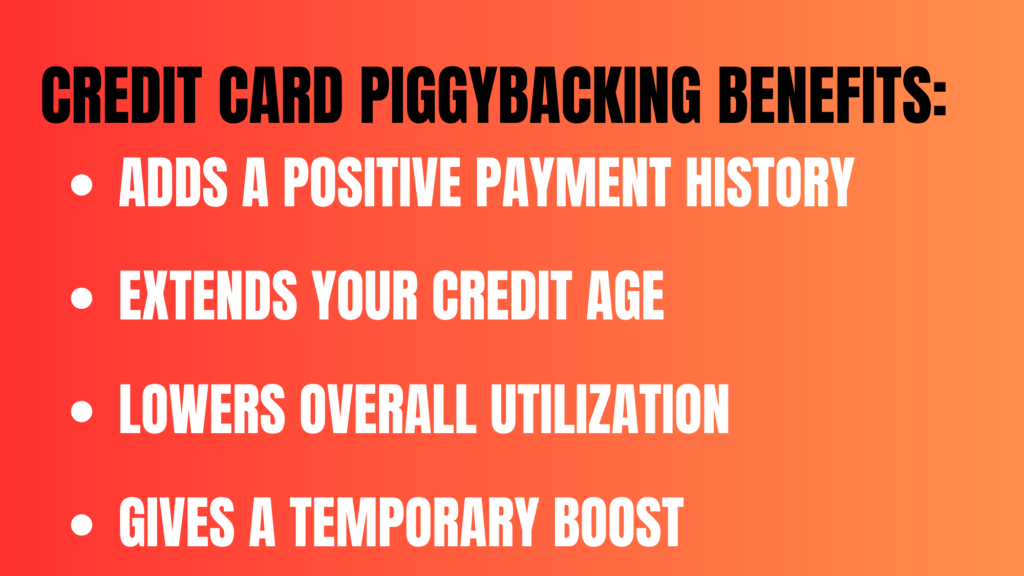
But remember, a higher score doesn’t equal higher trust. And lenders know it. Besides, there are many other ways to improve your credit for a mortgage; piggybacking is not your only option!
What Lenders Really Look For
If you’re within 6–12 months of applying for a mortgage, this section matters more than your credit score. When it comes to mortgage approval, your credit score is only one piece of the puzzle. Lenders (especially FHA and conventional underwriters) dig deeper into your financial habits.
They look at:
- Credit Depth: How many of the accounts on your report are actually yours?
- Payment History: Are your payments consistent and verifiable under your own name?
- Debt-to-Income Ratio (DTI): How much of your income goes toward debt payments?
- Stability: Do you have a proven track record of managing your finances responsibly?
In fact, many lenders completely remove authorized-user accounts when reviewing your credit for a mortgage. According to Fannie Mae’s underwriting guidelines, these accounts can’t be considered for manually underwritten loans unless the borrower can prove they’ve been making the payments themselves (For more information, read here).
That’s why a boosted score from piggybacking often doesn’t carry much weight during the actual loan review.
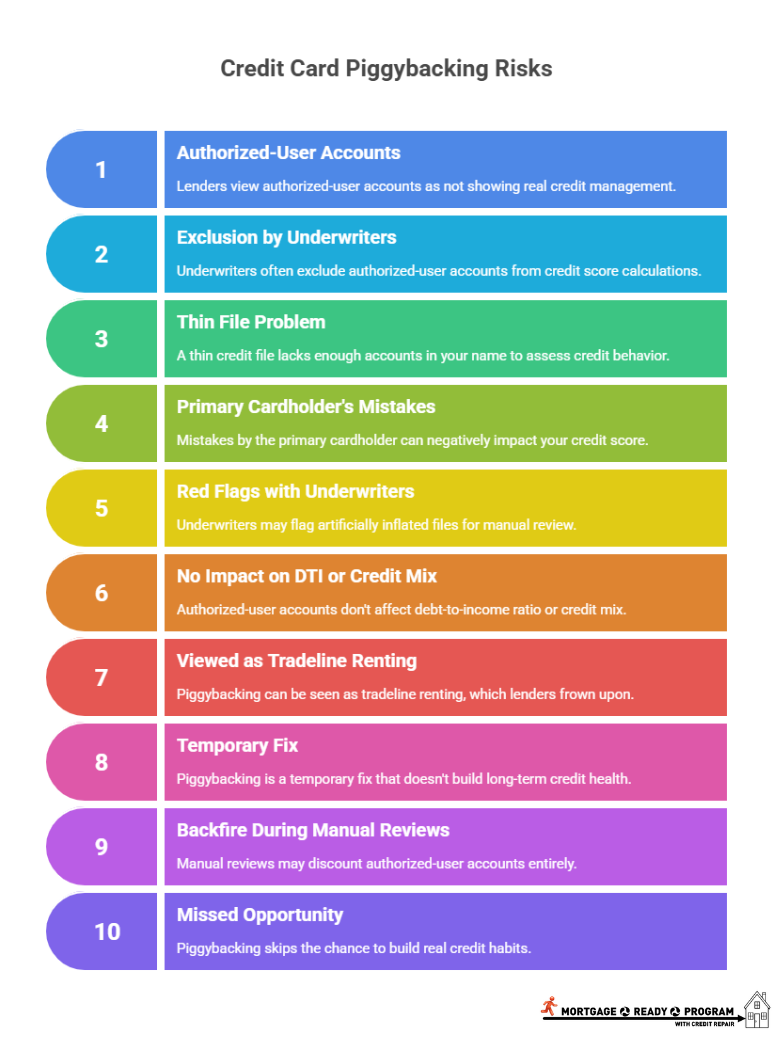
10 Reasons Why Piggybacking Doesn’t Help Your Mortgage Approval
1. It Doesn’t Show Real Credit Management
Lenders want evidence that you can manage credit, not someone else’s. Authorized-user accounts don’t prove you’ve made payments, handled due dates, or kept balances in check.
Think of it like borrowing someone else’s good reputation. It might look good from the outside, but it’s not yours to claim.
2. Lenders Often Exclude Authorized-User Accounts
Mortgage underwriters know the game. If they see a recent authorized-user account with a perfect history but no personal credit, they’ll often remove it from your score calculation entirely.
That means your artificially boosted score can drop right before closing, and that’s the worst possible time.
3. It Can Create a “Thin File” Problem
A “thin credit file” means your credit report doesn’t have enough accounts in your own name to show lenders how you actually manage debt. Even if your score looks good because of Credit Card Piggybacking, underwriters know those accounts aren’t truly yours. That makes it hard for them to assess your real payment behavior or financial reliability.
When a file looks thin, the automated system may not approve it, which can trigger manual underwriting, where a human underwriter digs deeper into your finances, rent history, or bank records to find proof of credit responsibility. If you can’t show a strong payment history under your own accounts, your loan can be delayed or denied.
4. The Primary Cardholder’s Mistakes Hurt You
Here’s the risky part: their mistakes become your consequences.
If that person makes a late payment or maxes out the card, your score can plummet overnight. Any late payment reported to the credit bureaus will have a swift and significant effect on your credit scores.
And the worst part? You have no control over it.
5. It Raises Red Flags with Underwriters
Seasoned loan officers can spot an artificially inflated file a mile away. If your report suddenly shows an aged tradeline you’ve never paid on, they may flag your file for manual review, delaying your loan approval.
Underwriters are trained to look for “data anomalies,” and new authorized-user accounts right before mortgage pre-approval are one of the biggest.
6. It Doesn’t Help Your DTI or Credit Mix
Your debt-to-income ratio (DTI) is one of the most important numbers in mortgage approval because it shows how much of your monthly income goes toward paying debt.
Here’s where Credit Card Piggybacking falls short: when you’re an authorized user on someone else’s credit card, that account isn’t legally your debt. You’re not responsible for the payments; the primary cardholder is. Because of that, lenders don’t include authorized-user accounts when calculating your DTI or evaluating your credit mix (the variety of credit types you manage). In other words, even if that card appears on your credit report, it doesn’t demonstrate your ability to take on and repay debt, which is exactly what mortgage underwriters need to see before approving your loan.
7. It Can Be Viewed as “Tradeline Renting”
There’s an entire online market where people pay strangers to be added as authorized users to boost their credit. This practice, known as tradeline renting, is frowned upon by lenders and can even be seen as credit manipulation.
If your lender suspects that you paid to be added to a stranger’s card, they could deny your application for misrepresentation.
It’s not worth the risk.
8. It Won’t Build Long-Term Mortgage Readiness
Piggybacking is a temporary fix. Once you’re removed from that account or the cardholder closes it, your score can drop again, sometimes by dozens of points.
Building real credit health means establishing consistent payment behavior over time, not borrowing someone else’s.
9. It Can Backfire During Manual Reviews
Government-backed loans like FHA, VA, and Fannie Mae often require manual underwriting for borderline applications.
During these reviews, underwriters look for personal responsibility in credit behavior. If your entire file is made up of authorized-user tradelines, they’ll discount them completely.
That means you’ll be judged only on your true accounts, and if there aren’t enough, approval can be denied.
10. You Miss the Opportunity to Build Real Credit Habits
Piggybacking skips the learning curve that actually builds mortgage readiness, things like budgeting, tracking due dates, managing balances, and using credit strategically.
Without those habits, new homeowners often struggle to handle the real responsibilities of a mortgage.
Remember: lenders want to see that you’re not just creditworthy, but financially ready for homeownership.
When Credit Card Piggybacking Can Backfire
Even well-intentioned piggybacking can go wrong. It tends to backfire when:
- The main account holder makes late payments or carries high balances.
- You rely only on piggybacked accounts and have no personal credit lines.
- The lender flags your file for “tradeline renting” or credit manipulation.
- The cardholder removes you before your loan closes, causing a sudden score drop.
If any of these happen mid-mortgage process, your approval could be delayed or denied entirely.
Conclusion
Credit Card Piggybacking might sound like a clever shortcut, and it can give your score a short-term bump, but it’s not a real path to mortgage readiness.
Mortgage lenders care about how you manage credit, not just what your score says. They want to see genuine, verifiable payment history, responsible credit use, and financial independence.
If you’re serious about buying a home, don’t rely on someone else’s credit to get there. Build your own. That’s the only strategy that lasts.
Ready to Build Real Mortgage-Ready Credit? Sign up Today!
We’ll help you understand what underwriters truly look for and design a step-by-step plan to make you mortgage-ready the right way.
Frequently Asked Questions
1. Does being an authorized user always help your credit score?
Not necessarily. If the main cardholder has late payments or high utilization, it can actually lower your score instead of improving it.
2. Can mortgage lenders tell if I’m an authorized user?
Yes. Underwriters can see whether a tradeline is joint, individual, or authorized-user status. They often disregard authorized-user accounts during manual reviews.
3. Is Credit Card Piggybacking illegal?
No, it’s legal. But tradeline renting (paying someone to add you to their card) can be seen as deceptive by lenders and may violate mortgage lending policies.
4. How long should I build my own credit before applying for a mortgage?
Aim for at least 12–24 months of consistent on-time payments and low balances. This gives underwriters enough history to evaluate your habits accurately.
5. Can I stay on my spouse’s or parent’s card if I’m already an authorized user?
Yes, but don’t rely on it as your main credit source. It can supplement your score, but you still need personal accounts to qualify for most mortgages.