

If you’re getting ready to apply for a home loan, your credit utilization before a mortgage application is one of the fastest levers you can pull to raise your score. Unlike your payment history, which takes years to build, utilization can shift in a single billing cycle — which makes it one of the most powerful (and most misunderstood) tools in your mortgage-prep toolkit.
The problem is that most advice stops at “pay down your cards.” It doesn’t tell you which cards, by when, or how the math actually works. This guide breaks down a real balance-prioritization framework, explains why your statement date matters more than your due date, clarifies the difference between aggregate and per-card utilization, and gives you a 60-day plan you can follow before you talk to a lender.
Table of Contents
What Is Credit Utilization, and Why Lenders Care
Credit utilization is the percentage of your available revolving credit that you’re currently using. If you have a $10,000 credit limit and a $3,000 balance, your utilization is 30%.
Utilization makes up roughly 30% of your FICO score, second only to payment history. Mortgage underwriters don’t look at utilization directly as an approval factor, but they absolutely look at the credit score it helps produce — and that score determines your interest rate, your loan program eligibility, and in some cases whether you’re approved at all. A jump from the low 700s into the mid-700s or higher can meaningfully lower your rate on a 30-year loan, which adds up to thousands of dollars over the life of the mortgage.
This is why credit utilization before mortgage applications deserves dedicated attention rather than a last-minute scramble.
Aggregate vs. Individual Utilization: Both Matter
This is the part most borrowers get wrong. Credit scoring models evaluate utilization two ways, and you need to manage both.
Aggregate utilization is your total balances across all revolving accounts divided by your total available credit. This is the number most people think of as “their utilization.”
Individual (per-card) utilization is the balance-to-limit ratio on each specific card. Scoring models flag any single card that’s maxed out or running hot, even if your overall aggregate number looks fine.
Here’s why this matters in practice: imagine you have three cards.
- Card A: $9,000 balance / $10,000 limit (90% utilized)
- Card B: $0 balance / $5,000 limit
- Card C: $0 balance / $5,000 limit
Your aggregate utilization is a reasonable-looking 45% ($9,000 / $20,000). But that single maxed-out card is dragging your score down independently of the aggregate figure, because scoring models penalize individual cards above roughly 30%, and especially anything near or above 90%. Two borrowers with the same aggregate utilization can have meaningfully different scores depending on how that debt is distributed across cards.
The practical takeaway: don’t just chase your overall percentage. Check every card individually, and treat any single card above 30% utilized as a priority, even if it’s a small balance in dollar terms.
Why Your Statement Date Matters More Than Your Due Date
This is the detail that trips up even financially disciplined borrowers. Most people assume that as long as they pay their bill in full by the due date, their utilization won’t hurt them. That’s not how it works.
Card issuers typically report your balance to the credit bureaus on your statement closing date — not your payment due date, which usually falls about three weeks later. If your statement closes on the 15th and you don’t pay down the balance until the due date on the 10th of the following month, the bureaus already received a snapshot of your higher balance weeks earlier. That reported number is what feeds your credit score, regardless of whether you paid it off in full immediately after.
This means you can pay your credit card bill in full, on time, every single month, and still show high utilization on your credit report — simply because of when the balance was reported relative to when you paid it.
What to do about it: Find each card’s statement closing date (it’s listed on your statement or in your online account under billing cycle details) and make a payment that brings the balance down before that date, not just before the due date. If you’re actively using a card for daily spending, consider making a mid-cycle payment a week or so before the statement closes so the reported balance reflects a low or zero amount.
A Balance-Prioritization Framework
Once you know your aggregate and per-card utilization and understand your statement dates, use this order of operations to decide where your dollars go first.
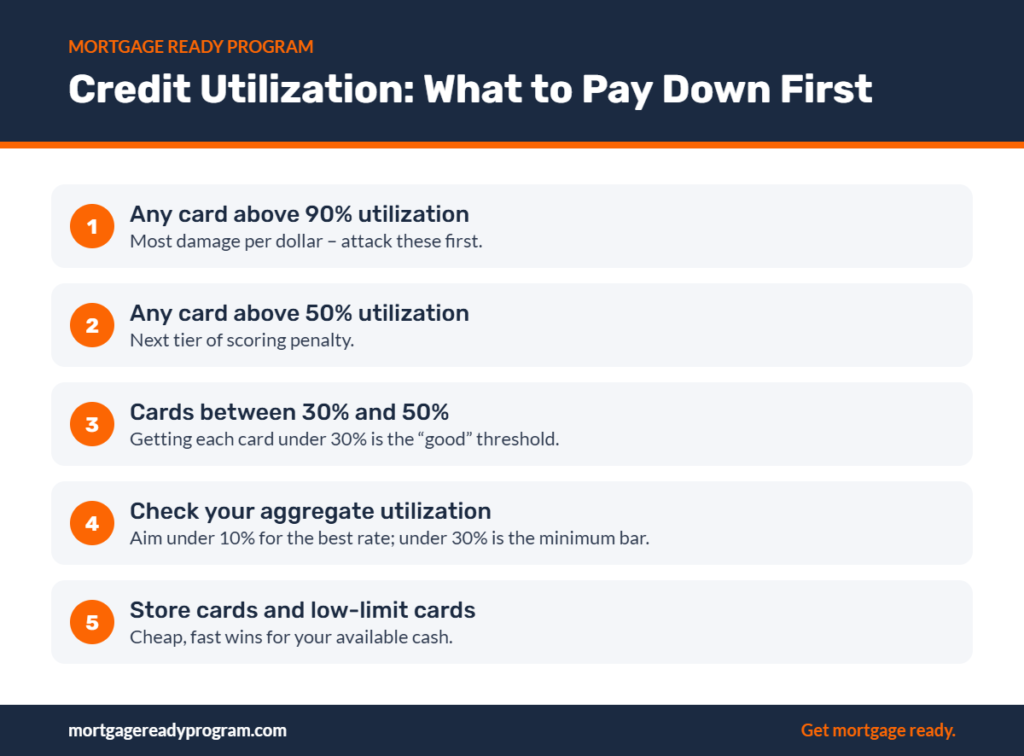
1. Any card above 90% utilization. These do the most damage per dollar of debt and are often flagged separately by scoring models as “maxed out.” Attack these first regardless of interest rate.
2. Any card above 50% utilization. These are the next tier of scoring penalty. Bringing these under 30% produces a noticeable score bump.
3. Cards between 30% and 50% utilization. Lower priority than the above, but still worth paying down if you have funds left, since getting under 30% per card is the generally recognized threshold for “good” utilization.
4. Your aggregate utilization as a check. After addressing individual cards, recalculate your total balances against total limits. Aim for aggregate utilization under 10% if you’re trying to maximize your score for the best possible mortgage rate; under 30% is the minimum bar to avoid being penalized.
5. Store cards and cards with low limits. These swing utilization percentages dramatically with small balances (a $200 balance on a $500 limit is 40% utilization) and are cheap, fast wins for your available cash.
A simple rule of thumb: pay down the highest percentage-utilized card first, not necessarily the highest-balance or highest-interest-rate card. Debt avalanche and snowball methods are built for interest savings — this framework is built for score optimization, which is a different goal during mortgage prep.
What Not to Do During This Window
A few common instincts actually work against you here.
Don’t close paid-off credit cards. Closing an account reduces your total available credit, which raises your aggregate utilization even if your balances haven’t changed — and it can shorten your average account age. Keep old cards open with a zero or low balance.
Don’t open new credit cards to “get more available credit.” A hard inquiry and a new account both temporarily ding your score, and a brand-new account lowers your average account age. This is not the time to chase a rewards card.
Don’t move all your debt onto one card via a balance transfer without checking the math first. Consolidating can help if it lowers your highest individual utilization, but it can also spike a single card to 90%+ and hurt more than it helps. Run the numbers before you transfer.
The 60-Day Action Plan
Here’s a week-by-week framework to bring your credit utilization before mortgage application into shape.
Days 1–5: Audit. Pull your full credit report and list every revolving account with its current balance, credit limit, individual utilization percentage, and statement closing date. Calculate your aggregate utilization. This is your baseline.
Days 6–14: Rank and plan. Apply the balance-prioritization framework above. Rank every card from highest to lowest utilization. Map out how much you can realistically pay toward each card over the next 45 days, and note each card’s statement date so you know exactly when a payment needs to post to affect that month’s reported balance.
Days 15–30: Attack the worst offenders. Focus all available extra cash on cards above 90%, then cards above 50%, following your plan. Time payments to land before each card’s statement closing date, not just before the due date.
Days 31–45: Continue paydown and recheck. Keep paying down the next tier of cards (30–50% utilization). Pull an updated credit report or use a monitoring service to see how your score has responded. Adjust your remaining budget toward whichever cards still show the highest individual utilization.
Days 46–55: Fine-tune aggregate utilization. With individual cards largely under control, check your aggregate number. If you’re not yet under 10–30%, direct remaining funds toward whichever cards get you there fastest. Avoid opening new accounts or making large purchases on any card during this window.
Days 56–60: Final check before applying. Confirm all reported balances reflect your paydown by checking your credit report after each relevant statement date has passed. Avoid any new credit inquiries, large purchases, or account closures in the days immediately before you submit your mortgage application, since lenders often re-pull credit close to closing.
The Bottom Line
Credit utilization before mortgage approval isn’t just about paying off debt — it’s about paying down the right cards, at the right time relative to your statement dates, while managing both your aggregate and individual ratios. A borrower who understands this framework can often raise their score meaningfully in 60 days, without paying a dollar more in total debt than a borrower who pays randomly. The difference is strategy, timing, and knowing exactly what the scoring models are measuring.
If you want help mapping this out for your specific situation before you apply, the team at Mortgage Ready Program can walk through your credit profile and build a personalized paydown plan ahead of your mortgage application.
Credit Utilization Before a Mortgage: Frequently Asked Questions
What credit utilization is best before applying for a mortgage?
Keeping overall utilization under 30% avoids most penalties, and under 10% is ideal if you want the best possible score and rate.
Should I pay off credit cards completely before a mortgage?
Paying balances down is usually helpful, but keep the accounts open. Letting a small balance report on one card can be fine; the bigger goal is low utilization on every card and overall.
How fast does paying down credit cards raise my score?
Utilization updates when your card issuer reports the new balance, usually after your statement closes. That means you can often see a change within 30 to 45 days, or faster with a lender’s rapid rescore.