
Every year, thousands of new real estate agents step into the industry with big dreams. They picture themselves driving clients to showings, handing over keys at closings, and enjoying the freedom of being their own boss. That initial glow is powerful. But unfortunately, reality often sets in quickly. According to the National Association of REALTORS®, 75 percent of new agents leave within their first year. By year five, the number climbs to 87 percent.
Why is failure so common? It’s not because these people lack intelligence or motivation. It’s because the real estate business is full of challenges that catch many by surprise. These challenges expose weaknesses, drain confidence, and leave people questioning whether they made the right career choice. But here’s the truth: challenges aren’t barriers. They are signals. They show you where to grow, where to adapt, and where to improve.
In this article, I’ll walk you through the real estate agents’ challenges that cause so many to quit, not just pointing them out, but explaining them in depth. More importantly, I’ll show you how you can turn them into opportunities. By the end, you’ll see how the Mortgage Ready Program can transform the way you do business and give you a pipeline of clients that keeps you moving forward even when the market feels tough. Let’s get started!
Table of Contents
Different Types of Real Estate Agents and Their Concerns
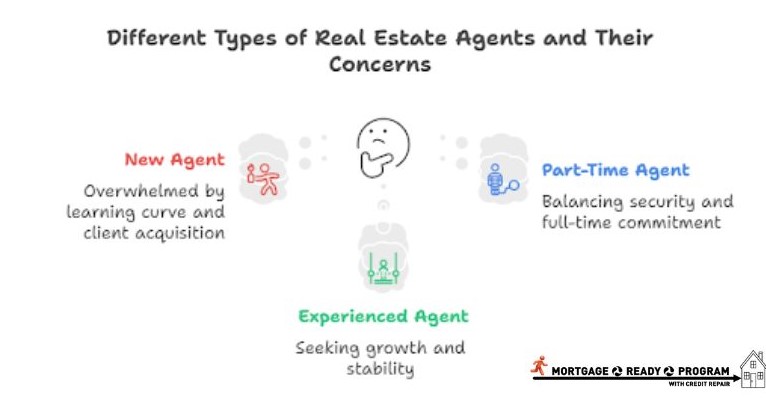
Not all agents are the same, and their struggles reflect where they are in their careers.
If you’re a new agent, you’re probably just trying to find your place. The learning curve feels steep. You’re overwhelmed by contracts, legalities, and processes, and on top of that, you need to figure out how to actually find clients. You may feel like you’re drinking from a firehose while your bank account is drying up.
If you’re an experienced agent, your challenges are different. You already know the basics, and you may even have a book of business. But you’re hungry for more. You want to grow, to add more transactions, to earn more income. At the same time, you may feel stuck, working harder but not necessarily scaling in a way that brings balance or long-term stability.
And if you’re a part-time agent, you’re caught in between. You want to make the leap to full-time real estate, but the fear of inconsistent income or leaving the security of another job keeps you from fully committing.
Different agents face different concerns, but all paths eventually lead back to the same set of challenges: inconsistent income, unpredictable lead generation, fierce competition, and the difficulty of standing out in a crowded field.
Key Real Estate Agents’ Challenges in Today’s Market
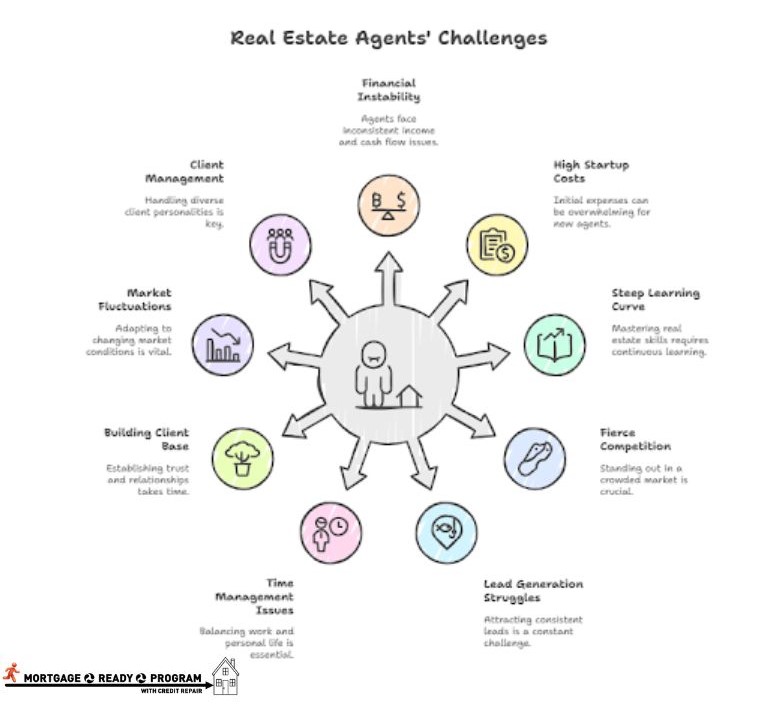
Inconsistent Income and Cash Flow Problems
Nothing shakes an agent’s confidence like inconsistent income. Unlike a traditional job with a steady paycheck, your earnings in real estate depend entirely on closed transactions. The reality is that you can spend months working with a client and still walk away with nothing if the deal falls through. For many, the gap between starting and actually closing their first deal is longer than expected. Without a financial cushion, this challenge alone can knock people out of the industry.
The solution is to treat your finances like a business, not a hobby. That means budgeting, setting aside reserves, and most importantly, building a pipeline that ensures closings are not random but consistent.
High Startup and Operational Costs
Getting licensed is only the beginning. Once you’re in, you face MLS fees, association dues, marketing costs, technology tools, and brokerage splits. Add to that your own branding materials like signs, cards, and websites, and you can easily spend thousands before you see your first commission check.
This is one of the biggest real estate agents’ challenges. They underestimate the financial demand of launching a career and find themselves buried before they ever hit stride. The key is to see these expenses not as costs but as investments. Every dollar should have a purpose and a return.
Steep Learning Curve
Real estate is not just about showing homes. It’s about contracts, negotiations, local laws, market analysis, mortgage knowledge, and client management. You’re expected to master all of that while projecting confidence to clients who are making the biggest purchase of their lives. That’s no small responsibility.
The best way to handle the steep learning curve is to approach the business with humility and a student mindset. Never stop learning. Seek mentorship, invest in training, and stay curious. Those who embrace the constant evolution of this industry are the ones who survive and thrive.
Fierce Competition and Market Saturation
In most markets, you’re not the only agent on the block. You’re competing with hundreds, sometimes thousands, of others. With so many options available, clients will only choose you if you give them a clear reason. That reason is rarely just price. It’s about trust, credibility, and the unique value you bring.
Agents who cannot answer the simple question, “Why should I hire you?” will find themselves struggling to get traction.
Lead Generation Struggles
If there is one universal truth in real estate, it’s this: no leads, no business. Lead generation is the lifeblood of every agent’s career. Yet it’s also the part that most agents struggle with the most. Cold calls, door knocking, open houses, they all work, but they’re exhausting and unpredictable.
The agents who succeed long-term are the ones who move from hustling for leads to building systems that bring them in consistently. This is where technology, marketing funnels, and programs like the Mortgage Ready Program become game-changers.
Time Management and Work-Life Balance
Among real estate agents’ challenges, one of the biggest misconceptions is that it offers complete freedom. In reality, many new agents find themselves chained to their phones, answering late-night calls, showing homes on weekends, and sacrificing personal time. Without balance, burnout sets in quickly.
The key is learning to prioritize. Not all tasks are equal. Focus on income-producing activities, delegate what you can, and create boundaries that allow you to protect your personal life.
Building a Client Base from Scratch
Trust takes time to build. In your first year, you might feel invisible. Clients don’t know you yet. Your phone isn’t ringing off the hook. That can be discouraging. But building a client base is like planting seeds. At first, you see nothing. But with consistency and nurturing, growth eventually shows. Every conversation, every post online, every follow-up call is part of building your foundation.
Market Fluctuations and Uncertainty
Markets rise and fall. Interest rates shift. Inventory dries up or floods in. These cycles are natural, but they can make or break an agent who isn’t prepared. Agents who treat good times as permanent often get caught off guard when things slow down. The resilient ones are those who diversify their pipeline and adjust quickly when the market changes.
Client Management Challenges
Clients can be your biggest blessing and your biggest test. Some will sing your praises, while others will test your patience with unrealistic expectations or difficult personalities. Managing emotions, setting boundaries, and keeping clients informed are essential skills that determine whether clients recommend you or regret working with you.
Modern Real Estate Agents’ Challenges Emerging in 2025
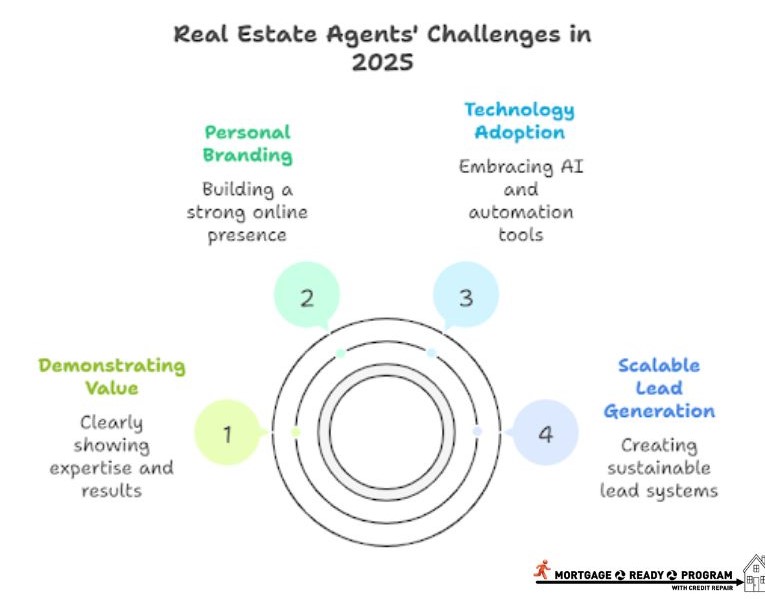
Increasing Transparency and Justifying Value
The commission lawsuits that swept through the industry in 2024 changed the way consumers view real estate agents. For years, commissions were bundled into the sales process in a way that few questioned. Now, buyers and sellers are far more aware of how those fees work, and many are asking tougher questions before agreeing to pay. They want to know, in plain terms, what value an agent actually brings to the table.
This shift means that holding a license is no longer enough. Agents who cannot clearly demonstrate their expertise, negotiation skills, market knowledge, and ability to deliver results will struggle to earn trust. On the other hand, those who can confidently explain their worth will rise above the competition and thrive in this new environment.
Shift Toward Personal Brand Over Brokerage
Clients don’t hire logos. They hire people. They research agents online before making a decision. If your personal brand is weak or nonexistent, you’ll be overlooked in favor of someone who shows up confidently online.
Staying Current with Technology and AI
AI tools are no longer optional. They are transforming how agents communicate, market, and generate leads. Those who embrace tools like ChatGPT or automation platforms are pulling ahead quickly. Those who ignore them risk becoming irrelevant.
Demands for Scalable Lead Generation Systems
Traditional prospecting methods alone are not sustainable. You need scalable systems that work even when you’re not personally knocking on doors. Automated lead funnels, targeted ads, and long-term nurturing campaigns are the future.
Common Reasons Why Real Estate Agents Fail
Failure is rarely about a single mistake. It’s usually the result of multiple small habits or blind spots that add up.
- Lack of funding and poor financial planning.
- Weak or inconsistent marketing and prospecting.
- No clear business plan or accountability system.
- Neglecting to build and nurture relationships.
- No unique value proposition that separates them from competitors.
- Poor communication skills, especially in writing and video.
- Ignoring technology and AI advancements.
- Failing to establish a personal brand.
- Relying on motivation instead of building systems.
- Neglecting the core activities of getting, serving, and keeping clients.
Each of these, on its own, can slow down your progress. Together, they lead to burnout and quitting.
Predictions: Why 50% of Agents Licensed Today May Not Survive Past 2026
The real estate industry is evolving at a pace many agents underestimate. It’s not that there won’t be enough homes to sell or clients to serve. The problem is that the expectations of today’s buyers and sellers have permanently changed.
Clients now expect real value. It’s no longer enough to open a door or fill out a contract. Consumers have access to listings online, market data on apps, and AI tools that answer their questions instantly. What they can’t get from an app is your negotiation skills, your ability to spot problems before they become costly mistakes, or the strategy you bring to helping them make a smart investment.
And then there’s digital presence. Today, most clients look you up before they even meet you. If they don’t see a professional online presence, social media, reviews, maybe even video, they assume you’re not serious. They want to work with the best-known agent, not necessarily the most experienced one.
On top of all that, technology is raising the bar. Agents who learn to leverage tools like AI, automation, and digital marketing will outpace those who rely only on old-school tactics. Technology doesn’t replace agents; it replaces agents who don’t adapt.
This is why so many agents won’t last. The ones treating real estate as a casual, part-time hustle will be replaced by professionals who run it like a business. Success is no longer about just getting a license. It’s about building systems, delivering value, and showing up consistently. Those who adapt will thrive. Those who don’t will fade out.
How Real Estate Agents Can Succeed in Today’s Market
I’ve talked a lot about real estate agents’ challenges, and if you’ve made it this far, it’s because you don’t want to be part of the 87 percent who give up. You want to be in the small group that makes it through the storms and builds a long-term, profitable career. I want to tell you something important: it is absolutely possible.
Yes, the industry is demanding more from you than ever before. Yes, the competition is fierce. But for the agent who is willing to adapt, learn, and leverage the right tools, this is actually the best time in history to be in real estate. The opportunities are endless if you approach this like a business and not just a side hustle.
So how do you succeed? Here’s where the path becomes clear.
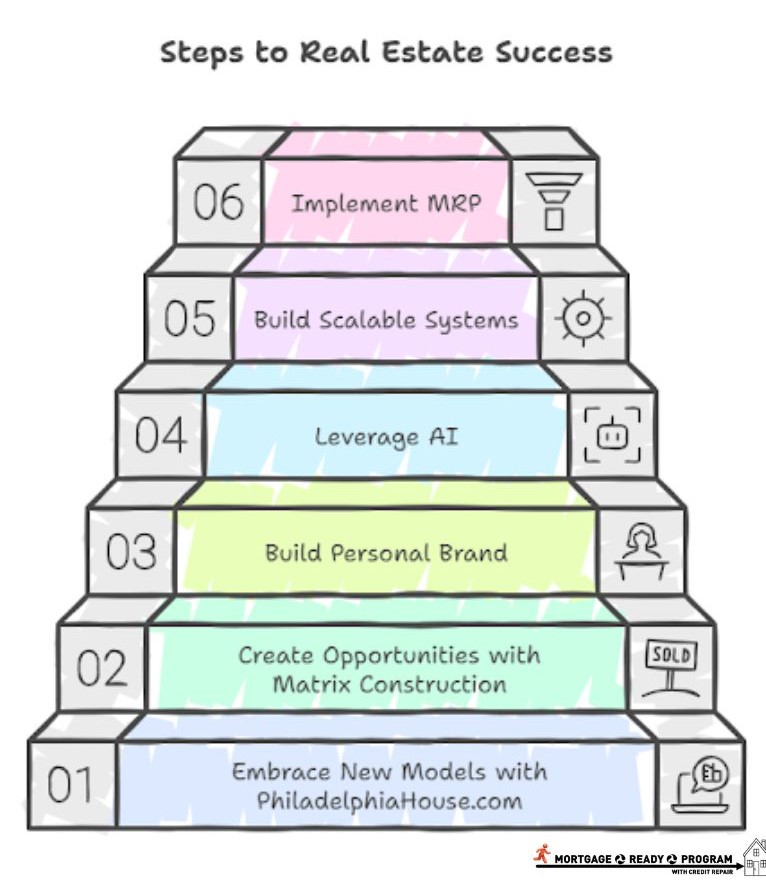
Embrace New Models with PhiladelphiaHouse.com
The old brokerage model takes too much from you while giving back too little. You don’t need to split half your commission just for the privilege of hanging your license on a wall. With PhiladelphiaHouse.com, you keep 100 percent of your commission. That alone can transform your income overnight.
But it’s not just about keeping your money. PhiladelphiaHouse.com gives you the tools, the training, and the support you need to actually succeed. From digital platforms that help you streamline your business to ongoing education that keeps you ahead of the curve, PhiladelphiaHouse.com equips you to run your real estate career like a true professional.
When you have the right model behind you, you stop bleeding money and start building wealth.
Create Opportunities Through Matrix Construction
One of the most overlooked opportunities in real estate is helping clients see potential where others only see problems. With Matrix Construction, you can do just that. Through renovation loan options like FHA 203(k), you can show buyers how to transform fixer-uppers into dream homes.
Imagine walking a client into a property they would normally reject because it “needs too much work.” Instead of walking away, you’re able to say, “What if I could help you roll the cost of those renovations into your mortgage and connect you with a trusted construction team?” Suddenly, a lost deal becomes a closed deal, and you’ve provided enormous value that most agents can’t match.
This isn’t just about saving deals; it’s about standing out as the agent who solves problems others can’t.
Build Your Personal Brand
In today’s market, people don’t hire a brokerage; they hire you. Buyers and sellers Google your name, check your social media, and watch how you show up online. If they don’t see anything, or if what they see doesn’t inspire confidence, they move on.
Building a personal brand isn’t about being flashy. It’s about being visible, consistent, and authentic. Use video, share market updates, and post success stories. Be the local expert people think of first. In real estate, the best-known agent almost always wins.
Leverage AI and Technology
Technology isn’t here to replace you; it’s here to multiply you. Agents who ignore tools like AI, automation, and digital marketing are working ten times harder than they need to. Meanwhile, agents who embrace these tools are producing content, generating leads, and managing their pipelines more efficiently than ever.
AI can help you write property descriptions, create email campaigns, draft social media posts, and even build scripts for video. It can help you stay top of mind without burning yourself out. The key is to see technology as a teammate, not a threat.
Build Scalable Systems
Too many agents live and die by their daily motivation. They prospect hard when they’re fired up and then crash when life gets busy. That’s not a business, that’s a rollercoaster.
If you want long-term success, you need systems that generate leads consistently, nurture clients automatically, and keep your pipeline full whether you feel motivated or not. This is where automation, digital funnels, and structured programs change the game.
Here’s the Big One: The Mortgage Ready Program (MRP)
This is where everything comes together. Let me make it crystal clear: this is the solution to the number one problem in real estate: inconsistent clients and inconsistent income.
With MRP, you never have to throw away a lead again. Instead of losing buyers who aren’t ready today, you place them into the program. While they work on improving their credit, building savings, or getting financing lined up, you stay connected. Over time, they move through the stages until they’re mortgage-ready. And when that day comes, you don’t lose them, you get them back. When you place your client in MRP, they are returned to you at the end of the program. You will also be able to track your client’s progress along the way. It’s designed as an Agent Referral program to keep your pipeline strong and your clients coming back to you.
Think about what that means. Instead of only working with clients who are ready now, you build a pipeline of buyers at every stage of readiness. That gives you short-term closings, medium-term opportunities, and long-term stability. Your business stops being a guessing game and becomes predictable.
MRP also helps you learn as you go. You’ll naturally pick up knowledge about mortgages, credit, and financing while the program does the heavy lifting for your clients. You don’t need to be an expert in everything; the system supports you while you grow into the professional you’re meant to be.
If you take nothing else from this article, take this:
The agents who survive and thrive are the ones who build pipelines, create systems, and leverage tools like MRP to turn “not yet” into “one day soon.”
Final Thoughts: Turning Real Estate Agents’ Challenges Into Opportunities
The real estate business is not easy. The statistics prove it. But if you look deeper, you’ll see that every challenge also carries a solution. Inconsistent income pushes you to build systems. High competition forces you to develop a unique identity. Market fluctuations teach you resilience.
The agents who survive are not the ones who avoid challenges. They are the ones who embrace them, learn from them, and use them as fuel for growth.
Don’t be part of the 87 percent who quit. Be part of the group that adapts, thrives, and builds a business that lasts. The Mortgage Ready Program exists to help you get there. The choice is yours. You can treat challenges as roadblocks, or you can see them as stepping stones to your future success.
Questions? Let us know in the comments below!



0 Comments