
If you are preparing to buy a home, finding an error on your credit report can make you want to dispute it immediately. But when a mortgage application is approaching, what not to dispute before a mortgage can be just as important as knowing what should be corrected.
Credit disputes are designed to address information you believe is inaccurate, incomplete, or otherwise incorrect. They should not be used simply because an account is hurting your credit score.
Timing matters, too. An active dispute or dispute comment on a credit report can create additional questions during the mortgage process. Depending on the loan program, account, lender, and circumstances, you may need to resolve a dispute before underwriting can move forward.
That does not mean you should ignore legitimate credit report errors. It means that mortgage preparation should be deliberate.
In this guide, we’ll explain:
- What not to dispute before applying for a mortgage
- How active dispute comments can affect the mortgage process
- The difference between factual and blanket disputes
- Why timing matters
- What to do if you find an error shortly before applying
- When to coordinate with your lender.
Table of Contents
Why Credit Disputes Matter When You’re Preparing for a Mortgage
Mortgage lenders evaluate more than the credit score you see on a consumer credit monitoring service.
Your credit history, monthly debts, payment patterns, outstanding balances, derogatory accounts, and other information may all play a role in determining whether you qualify.
A credit dispute can affect how information on an account is evaluated or reported while the dispute is being investigated.
That creates an important distinction:
Disputing inaccurate information months before you apply for a mortgage is different from starting several disputes immediately before underwriting.
If you’re planning to apply soon, the goal should be to make sure your credit report is accurate, stable, and ready for lender review.
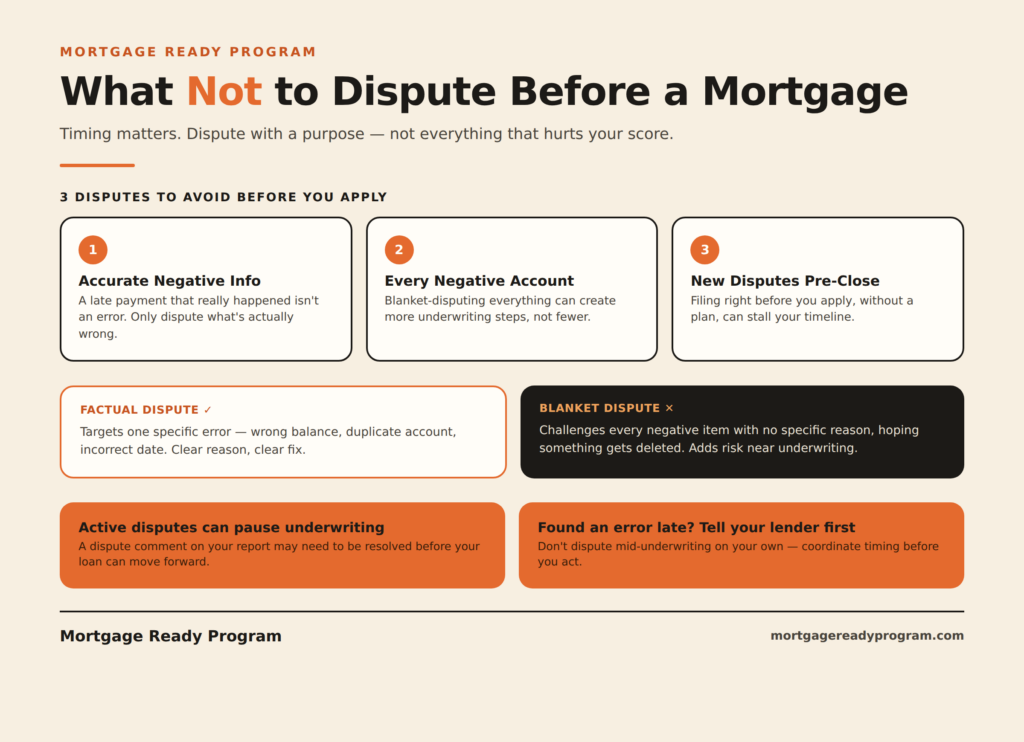
What Not to Dispute Before a Mortgage
There is no single list that applies to every borrower. However, several types of disputes deserve extra caution when you’re approaching a mortgage application.
1. Don’t Dispute Accurate Negative Information Just Because It’s Negative
A negative account isn’t necessarily inaccurate.
For example, suppose your credit report shows a late payment from two years ago. If you were actually late, disputing the payment simply because it is lowering your score is not the same as identifying a factual reporting error.
A legitimate dispute should be based on something you believe is inaccurate or incomplete.
Examples could include:
- An account that doesn’t belong to you
- An incorrect balance
- An incorrect payment history
- A duplicate account
- An account incorrectly reported as open
- Incorrect dates
- A payment reported late that you believe was made on time
The key is identifying the specific information you believe is wrong.
2. Don’t Blanket-Dispute Every Negative Account
One of the biggest mistakes consumers can make is disputing multiple negative accounts without identifying specific inaccuracies.
This is sometimes referred to as a blanket dispute approach.
Someone might dispute:
- Every collection
- Every late payment
- Every charge-off
- Every negative account
The assumption is often that disputing more accounts creates a better chance of improving the credit score.
But if you’re preparing for a mortgage, this strategy can create unnecessary complications.
Multiple active disputes may need to be reviewed or resolved before the mortgage process can proceed. Instead of helping you become mortgage-ready, poorly timed disputes can potentially create another step between you and underwriting.
3. Don’t Start New Disputes Immediately Before Applying Without Considering the Timing
Imagine that you plan to seek mortgage pre-approval next week.
You review your credit reports and notice several items you want investigated.
Immediately disputing all of them may not be the best first step.
A dispute investigation can take time, and your credit reports may show that an account is currently being disputed while the investigation is underway.
If you’re close to applying, first determine:
- Is the information actually inaccurate?
- How significant is the error?
- How soon do you expect to apply?
- Is there enough time for the dispute process to be completed?
- Should your lender be consulted before you make a change?
Sometimes correcting an error before applying makes sense.
Other times, the timing should be coordinated with the mortgage professional handling your application.
What Is an Active Dispute Comment on a Credit Report?
When you dispute information with a credit bureau or creditor, your credit report may indicate that the account is being disputed.
You might see language indicating that the consumer disputes the account information.
This is commonly called a dispute comment or dispute notation.
The important issue for a future homebuyer isn’t simply that the words appear on the report. It is how the disputed account is treated during the mortgage qualification and underwriting process.
Depending on the circumstances, an active dispute may need additional review.
That can become particularly important when the disputed account contains derogatory information.
Why Active Credit Disputes Can Affect Mortgage Underwriting
Mortgage underwriting is ultimately about assessing risk using verified financial information.
The underwriter wants a clear picture of your:
- Credit history
- Debt obligations
- Income
- Assets
- Payment history
- Overall financial position
An active dispute can introduce uncertainty into that picture.
Depending on the loan program and circumstances, disputed information may receive different treatment by credit scoring systems or mortgage underwriting systems.
If an underwriter requires the dispute to be resolved, you could find yourself addressing it during the mortgage process instead of before it.
That is why credit preparation should happen before you start shopping seriously for a home whenever possible.
Factual Disputes vs. Blanket Disputes
Understanding this difference is extremely important when preparing your credit for a mortgage.
What Is a Factual Credit Dispute?
A factual dispute identifies a specific piece of information that you believe is inaccurate or incomplete.
For example:
A credit card account reports a 30-day late payment for March, but your records indicate the payment was made on time.
The issue is specific.
Another example:
A collection account appears twice on your credit report with the same creditor, balance, and account information.
Again, there is a specific reporting issue to investigate.
What Is a Blanket Dispute?
A blanket dispute generally challenges negative information without identifying a meaningful factual problem with each item.
For example:
Dispute every negative account on my credit report.
That’s very different from identifying specific inaccuracies.
For a future homebuyer, the objective shouldn’t be to generate as many disputes as possible.
The objective should be to make sure your credit reports accurately represent your credit history while avoiding unnecessary complications before mortgage underwriting.
Should You Dispute a Collection Before Applying for a Mortgage?
It depends on the circumstances.
First ask: What exactly is inaccurate about the collection?
If the account isn’t yours, the balance is incorrect, or another piece of information is wrong, you may have a legitimate reason to investigate and dispute it.
But if the collection is accurate and you’re considering disputing it only because you’re hoping it disappears before your mortgage application, that is a different situation.
You should also consider your mortgage timeline.
If you’re already working with a lender, discuss the account before making changes that could affect your credit report during underwriting.
Should You Remove Dispute Comments Before Applying for a Mortgage?
This is another situation where borrowers should avoid making assumptions.
An active dispute comment may need to be addressed depending on the account, mortgage program, and lender requirements.
But don’t automatically start calling creditors or bureaus and removing every dispute notation without understanding why it exists.
Instead, determine:
- Which accounts have dispute comments
- Whether the underlying information is accurate
- Whether the dispute is still active
- Whether you’re currently working with a lender
- Whether the lender wants the dispute resolved or comment removed
If you’re already in the mortgage process, coordinate with your lender before making changes.
When Should You Dispute Credit Report Errors Before Buying a House?
Ideally, credit preparation begins well before you apply for a mortgage.
Starting several months ahead gives you more time to:
- Review all three credit reports
- Identify actual inaccuracies
- Gather supporting documentation
- Submit appropriate disputes
- Allow investigations to be completed
- Review the results
- Make sure updated information is being reported correctly
- Work on balances and other credit factors
Waiting until you’ve found a house can put unnecessary pressure on the process.
The earlier you understand your credit situation, the more options you generally have.
What If You Find a Credit Error Right Before Applying?
Don’t panic, but don’t automatically dispute it either.
First, document the issue.
Determine exactly what you believe is incorrect and gather supporting information.
Then consider where you are in the mortgage process.
If You Haven’t Applied Yet
You may have more flexibility to address the issue before beginning your application.
If the issue could materially affect mortgage qualification, consider speaking with a knowledgeable mortgage professional about your timing.
If You’re Already Working With a Lender
Tell your lender what you found.
Don’t assume that changing your credit report in the middle of underwriting will automatically improve your situation.
Your lender can tell you whether the issue needs to be addressed and how it may affect the mortgage process.
If You’re Already Under Contract
Timing becomes even more important.
A home purchase has deadlines. Starting an unnecessary credit dispute during this period could create complications at exactly the wrong time.
Coordinate with your lender before taking action.
What Should You Do 60–90 Days Before Applying for a Mortgage?
If possible, give yourself a preparation window before seeking pre-approval.
60–90 Days Before Applying
Review all three credit reports carefully.
Look for:
- Incorrect late payments
- Accounts you don’t recognize
- Duplicate accounts
- Incorrect balances
- Incorrect account status
- Incorrect dates
- Collections that don’t belong to you
- Active dispute comments
Create a list of anything that needs further investigation.
30–60 Days Before Applying
Address legitimate inaccuracies while continuing to manage your existing accounts responsibly.
Also focus on fundamentals such as:
- Making every payment on time
- Reducing credit card utilization
- Avoiding unnecessary new debt
- Building savings
- Organizing income and asset documentation
Final 30 Days Before Applying
Stability becomes especially important.
Avoid making major credit changes simply because you think they might increase your score.
Before opening accounts, closing accounts, moving balances, disputing accounts, or making other significant changes, consider how the decision fits into your mortgage timeline.
Don’t Focus Only on Removing Negative Items
This is where mortgage credit preparation differs from generic “credit repair.”
Your goal isn’t simply to make a credit report look better.
Your goal is to become mortgage-ready.
A lender will evaluate much more than whether negative items exist.
Your overall mortgage readiness can include:
- Credit
- Income
- Assets
- Debt obligations
- Employment
- Documentation
- Savings
- Payment history
Someone can have an improved credit score and still not be ready for a mortgage.
That’s why your credit strategy should be connected to your overall homebuying plan.
When Should You Coordinate With a Lender?
If you’re already working with a lender or expect to apply very soon, communicate before making significant credit changes.
Consider speaking with your lender when:
- You’re within weeks of applying
- You’ve already been pre-approved
- You’re under contract for a home
- An active dispute appears on your mortgage credit report
- You’re considering disputing a major derogatory account
- An underwriter has asked about a disputed account
- You’re unsure whether resolving a dispute could affect qualification
The closer you are to underwriting, the more important coordination becomes.
Your lender is evaluating your credit for a specific mortgage program. What matters for one borrower or loan program may not be identical for another.
Credit Repair for Homebuyers Should Have a Mortgage Strategy
Credit improvement before buying a home should not happen in isolation.
The question isn’t simply:
“How can I improve my credit?”
A better question is:
“What should I do with my credit based on when I want to qualify for a mortgage?”
That difference matters.
If your credit needs work before you apply, learn more about our Credit Repair for Homebuyers approach and how credit preparation can fit into a broader mortgage-readiness plan.
Frequently Asked Questions About Credit Disputes Before a Mortgage
Can a Credit Dispute Stop Me From Getting a Mortgage?
Not automatically. However, certain active disputes can require additional review or resolution depending on the account, loan program, lender, and underwriting requirements.
This is why you should not assume that disputing an account immediately before applying will improve your chances of approval.
How Long Before a Mortgage Should I Stop Disputing Credit?
There isn’t one universal deadline that applies to every borrower.
The appropriate timing depends on what you’re disputing, whether the information is actually inaccurate, how quickly the issue can be resolved, and where you are in the mortgage process.
If you’re approaching pre-approval or underwriting, coordinate with your lender before starting new disputes.
Should I Dispute Every Collection Before Applying for a Mortgage?
No. A negative account shouldn’t be disputed merely because it’s negative.
Review each collection individually and identify whether there is a legitimate factual issue with the information being reported.
Can I Dispute an Incorrect Late Payment Before Buying a House?
Yes, if you believe the late payment is being reported inaccurately, you have the right to dispute inaccurate information.
However, your mortgage timeline matters. If you’re already in underwriting or close to applying, coordinate the timing with your lender.
Is It Better to Dispute Credit Before or After Pre-Approval?
When legitimate errors exist, addressing them well before pre-approval may give you more time for the investigation and reporting process to be completed.
If you’ve already been pre-approved, speak with your lender before initiating new disputes that could affect the credit information being used for your loan.
Can I Just Dispute Something to See If It Gets Deleted?
That is not a good mortgage-readiness strategy.
Credit disputes should address information you believe is inaccurate or incomplete. Blanket-disputing accurate negative information can create unnecessary activity on your credit reports without addressing the underlying issues that may affect mortgage qualification.
The Bottom Line: Dispute With a Purpose
Understanding what not to dispute before a mortgage can help you avoid unnecessary complications at an important point in the homebuying process.
The goal isn’t to avoid legitimate disputes. If information on your credit report is inaccurate, you have the right to challenge it.
The key is to dispute with a purpose.
Identify the specific information that is wrong. Keep documentation. Give yourself enough time. Avoid blanket disputes. And when you’re approaching pre-approval or underwriting, coordinate significant credit changes with your lender.
Mortgage readiness is about more than improving a credit score.
It’s about making sure your credit, income, assets, and documents are prepared before you apply.


0 Comments